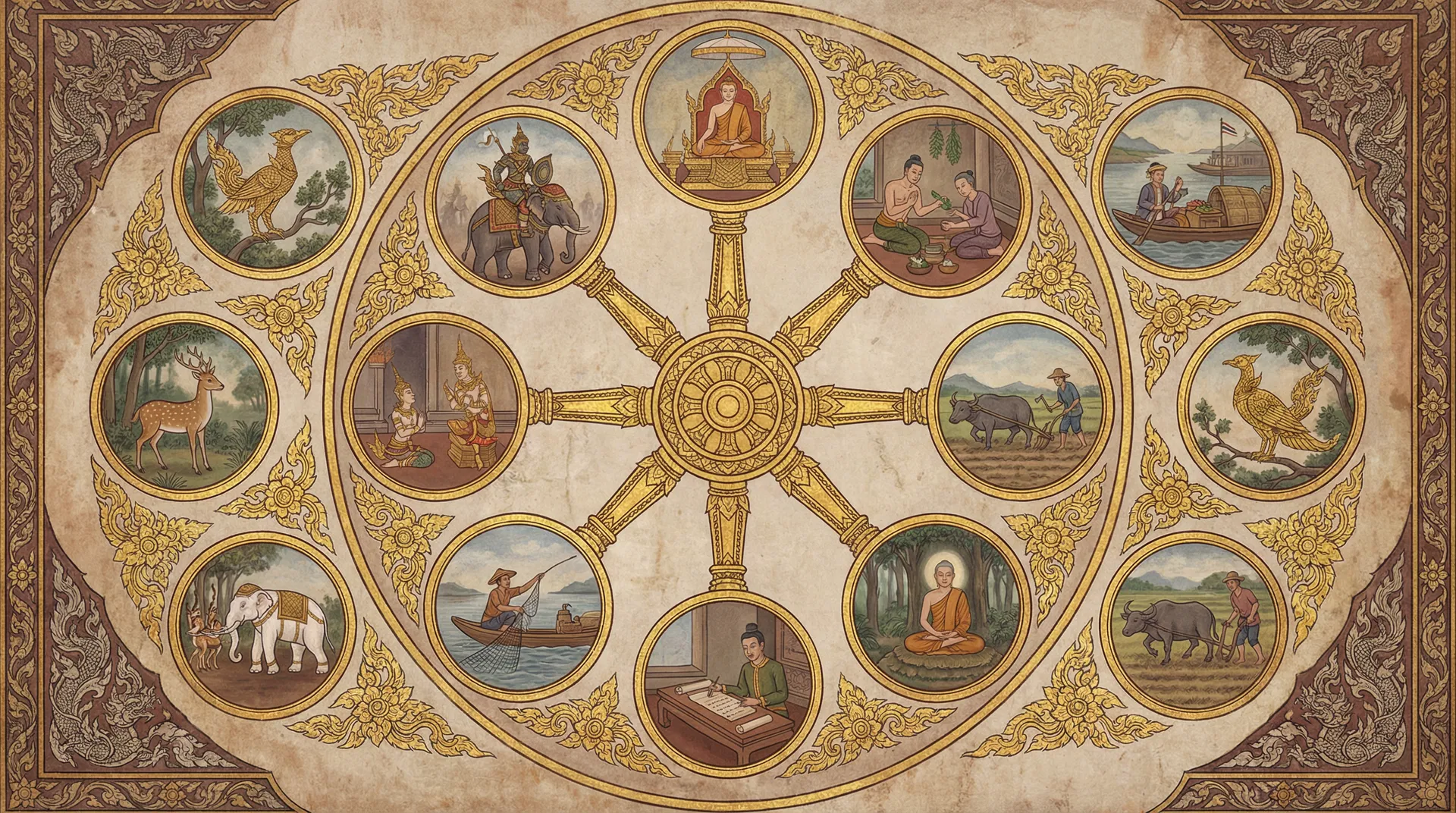
Saketa Jātaka
Saketa Jātaka
In the bustling city of Saketa, a place renowned for its vibrant markets and magnificent temples, there lived a wealthy merchant named Anathapindika. His name, meaning 'Provider for the Helpless,' was a testament to his generous spirit. He was known throughout the land for his immense wealth, but even more so for his boundless charity. He spared no expense in feeding the hungry, clothing the naked, and sheltering the destitute. His heart overflowed with kindness, and his actions were a constant stream of selfless giving.
Yet, despite his vast fortune and his noble deeds, Anathapindika harbored a secret sorrow. He longed for a son who would inherit not only his wealth but also his compassionate spirit. He had two sons, but they were vastly different from him. They were frivolous, extravagant, and utterly uninterested in the welfare of others. They spent their days squandering his hard-earned money on lavish parties, fine clothes, and fleeting pleasures, showing no regard for the suffering of those less fortunate.
Anathapindika often pleaded with them. "My sons," he would implore, his voice heavy with disappointment, "your father's wealth is a gift, meant to be shared. True richness lies not in hoarding, but in giving. Help those in need, and you will find true happiness."
But his sons would scoff. "Father," they would retort, their faces dismissive, "you are too soft-hearted. Wealth is meant to be enjoyed! Why waste it on beggars and vagrants? We are destined for a life of luxury, not hardship."
One day, Anathapindika decided to test his sons' character. He summoned them and said, "I have a task for you. I wish to make a significant donation to a group of ascetics who live in the forest. I will give you a large sum of gold, and I want you to travel to their hermitage and present it to them with due respect." He hoped that this act of giving, under his guidance, might instill in them a sense of purpose and generosity.
The sons, eager for the adventure and the opportunity to handle a large sum of money, readily agreed. They took the gold, mounted their finest horses, and set off, envisioning the feasts and revelries they would indulge in on the way. They traveled for a day, and as night fell, they found themselves in a small village. Instead of seeking out the ascetics, they found a tavern and proceeded to spend the gold on drinking, gambling, and boisterous entertainment, laughing at their father's naive trust.
Meanwhile, Anathapindika, despite his sons' failure, did not despair. He knew that true charity was a matter of the heart, and his own heart was unwavering. He decided to undertake the journey himself. He gathered a generous offering of food, clothing, and medicine, and set out alone towards the forest hermitage.
He traveled for days, facing difficult terrain and enduring hardships. He spoke to villagers along the way, inquiring about the ascetics. Many had never heard of them, but he persisted, his determination fueled by his unwavering commitment to the Dhamma.
Finally, after a long and arduous journey, he arrived at a secluded clearing deep within the forest. There, he found a group of ascetics, their bodies emaciated, their faces serene, living a life of extreme austerity. They possessed nothing, yet their eyes shone with a profound inner peace. They were practicing the Dhamma in its purest form, detached from worldly possessions and desires.
Anathapindika approached them with deep reverence. He bowed low and presented his offerings, explaining that he had sent his sons with a similar gift, but they had failed to reach them.
The chief ascetic, a man whose wisdom seemed to radiate from him, smiled gently. "Merchant Anathapindika," he said, his voice like a soft breeze, "we have no need for worldly possessions. Our path is one of renunciation. However, your intention, your pure heart, and your willingness to undertake this difficult journey for the sake of giving – that is the true offering. Your sons, by their actions, have shown their attachment to the fleeting pleasures of the world. But you, by your journey and your sincere desire to give, have shown your deep understanding of true wealth."
The ascetic continued, "The gold they squandered was a burden to them, a source of attachment and delusion. Your journey, though arduous, was a path of liberation for you. You have gained merit not from the gold, but from your effort, your sincerity, and your compassionate intention. This is the true Dharma of giving."
Anathapindika listened with profound understanding. He realized that his sons' failure was a reflection of their own spiritual poverty, while his own journey, despite its physical hardships, had enriched his soul. He spent some time with the ascetics, learning from their wisdom and reflecting on the true meaning of generosity.
Upon his return to Saketa, Anathapindika found that his sons had squandered all the gold. They were now impoverished and remorseful, finally understanding the emptiness of their pursuits. Seeing their genuine regret, Anathapindika, with his ever-present compassion, did not condemn them. Instead, he began to teach them the principles of the Dhamma, guiding them towards a path of righteousness and selfless service. He saw in their remorse the first glimmer of hope, the possibility of them one day understanding the true nature of wealth and happiness.
The story of Anathapindika's journey and his sons' folly became a legend in Saketa, a reminder that true wealth is not measured by possessions, but by the purity of one's intentions and the generosity of one's heart.
— In-Article Ad —
💡Moral of the Story
True wealth is not in possessions but in the purity of intention and the generosity of one's heart. Material wealth is fleeting, but the merit gained from selfless giving endures.
Perfection: Generosity (Dana)
— Ad Space (728x90) —
More Jataka Tales You May Enjoy
 213Dukanipāta
Mahasutasoma Jataka
The Bodhisattva's Compassion for the King of the SerpentsIn a time long past, when the forests teeme...
💡 The greatest act of compassion is to willingly sacrifice oneself for the well-being of others, demonstrating that true strength lies in selfless love and universal kindness.
206DukanipātaKosiya Jataka
Kosiya Jataka In the ancient city of Varanasi, nestled beside the sacred River Ganges, there lived a...
💡 True wealth is not measured by possessions, but by the generosity and compassion shown to others. The greatest joy comes from alleviating suffering and contributing to the well-being of the community.
 251Tikanipāta
Nandiya-Jātaka
Nandiya-JātakaIn the heart of a lush forest, where ancient trees whispered secrets to the wind and s...
💡 True fulfillment and lasting happiness are found not in worldly possessions or power, but in detachment, simplicity, and the pursuit of spiritual enlightenment. The greatest leadership is often demonstrated through selfless sacrifice and the courage to follow one's highest calling.
198DukanipātaMahosadha Jātaka
The Tale of the Brilliant Sage MahosadhaIn the magnificent city of Mithila, there lived a Bodhisattv...
💡 True ownership is demonstrated through genuine care, responsibility, and concern for the well-being of what one possesses, rather than mere assertion of claim or possession.
218DukanipātaMasa Jataka
Masa JatakaIn a serene monastery nestled amidst rolling hills, lived a devout monk named Bodhisattva...
💡 Attachment to desires and possessions leads to suffering. True contentment comes from inner peace and detachment, not from external things.
244DukanipātaSasa Jataka
Sasa JatakaHigh in the celestial abode, Sakka, the King of Gods, often descended to the mortal realm...
💡 Supreme compassion and selfless sacrifice are the highest virtues, capable of inspiring all beings and leaving an eternal legacy.
— Multiplex Ad —